Why making up stories is a superpower for your child's language development
We all know how important it is to read to our kids. It’s the classic advice parents hear from day one: "Read a book together every day." And for good reason—reading aloud builds vocabulary and language understanding. But what if I told you that’s only half the story?
There’s an even more powerful engine for language development that often gets overlooked: active language production—making up stories together.
While reading aloud gives your child language input, inventing stories gives them the chance to create output. Recent research shows that the real magic happens in a child’s brain when they shift from listening to creating. In this article, we’ll explore the science behind storytelling and share how you can spark this superpower in your child, from toddler to tween.
The 'Active Language' Paradox: Why listening is silver, but telling is gold
Many parents worry about whether their child knows enough words. We tend to focus on input: How many books do we have? How often do we read? But the biggest leap in brain development happens when a child goes from listener to storyteller.
The difference between passive and active
When your child listens to a story, their brain is in a relatively passive, receptive mode—recognizing words and patterns. But as soon as they have to invent a story themselves, their brain gets a workout.
This is what we call the active language paradox: it takes more effort, but the rewards are exponential.
- Word finding: Your child has to actively search for the right word in their memory, not just recognize it.
- Sentence complexity: To make a story make sense, they need to connect ideas, using words like "because," "although," and "then."
- Planning: Telling a story means thinking ahead. "If the dragon breathes fire, what should the knight do next?"
Studies show that kids who regularly tell their own stories use sentences that are 20% to 30% more complex than in everyday conversation. Storytelling stretches their language skills in ways casual talk doesn’t.
What happens in the brain? (Neuroscience Light)
Inventing a story is a real workout for a child’s brain. It taps into what are called executive functions—the mental skills essential for success in school and beyond.
- Working memory: Your child needs to remember who the main character is and what’s happened so far, all while figuring out what comes next.
- Cognitive flexibility: If the story gets stuck, their brain has to find a creative solution. "Oh no, the door is locked! Now what?" This builds problem-solving skills.
- Empathy and perspective-taking: To tell a good story, kids have to imagine how someone else feels. "How does the bunny feel now that he’s lost his carrot?" Research shows that storytelling helps children understand others’ feelings and thoughts.
At Mr Tales, we believe this mental gymnastics isn’t just great for language—it’s a huge confidence booster. A child who learns they can invent solutions for their heroes will carry that confidence into real life.
The Storytelling Growth Map: What to expect at each age
Many parents wonder, "Is my child on track? Is this normal?" Language development can be unpredictable, but there’s a clear pattern in how storytelling skills grow.
Here’s an overview based on insights from language experts and child development research.
Stage 1: The Associative Storyteller (Ages 2–4)
At this stage, there’s not really a plot yet. Stories are a string of associations.
- Hallmark: Lots of "And then... and then..."
- Example: "The dog walks in the woods. And then he saw a car. And I have a car. And then he went to sleep."
- How to encourage: Celebrate every sentence. It’s about the joy of talking, not logic.
Stage 2: The Budding Architect (Ages 4–6)
Now, structure starts to emerge. Kids begin to understand that stories have a beginning, middle, and end.
- Hallmark: Introduction of a "problem" or conflict. There’s a hero and often a villain (a monster, a naughty wolf).
- Development: They start making cause-and-effect connections. "The bear is crying because he’s hungry."
- How to encourage: Ask why. "Why is the bear doing that?" This helps build logical connections in language.
Stage 3: The World Builder (Ages 7–12)
In elementary school, language gets more abstract and storylines get more complex.
- Hallmark: Attention to characters’ inner worlds (feelings, plans, deception). Stories have layers and plot twists.
- Development: Kids can play with time (flashbacks) and perspective.
- How to encourage: This is the perfect age to capture stories. Kids are aware of an audience and want to create something "real."
5 playful ways to spark your child's imagination
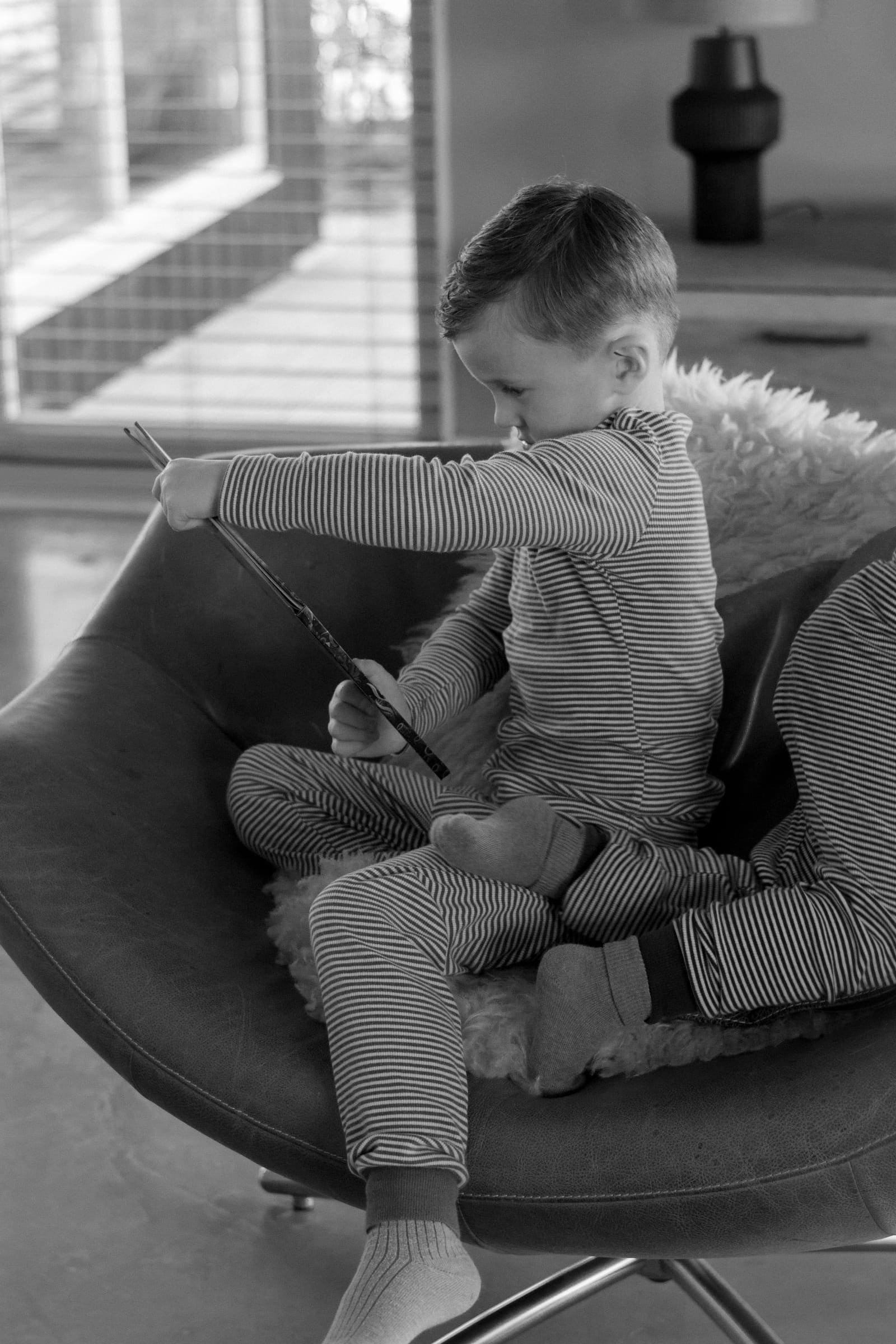
Even the most creative kids can freeze up when you ask, "Tell me a story!" The pressure can be too much. Here are five playful ways to get the story engine running—without it feeling like homework.
1. Story Relay
Start with a single sentence: "Once there was an astronaut who was afraid of the moon..." You take a turn, your child takes the next. By guiding the structure, you make it safe for your child to jump in.
2. The 'What if' question
Ask an impossible question. "What if our cat could talk?" or "What if it rained gummy worms tomorrow?" This takes the focus off "telling a good story" and turns it into a fun, creative conversation.
3. Mystery Bag
Put five random objects in a bag (a spoon, a toy car, a feather, etc.). Let your child pick three without looking. The challenge: make up a story that includes all three. This forces the brain to make creative connections.
4. Drawing as a jumpstart
Sometimes words get stuck, but pictures flow. Have your child draw the main character first. Then ask, "Who is this? What will they do?" At Mr Tales, we see that kids who struggle to write often unlock amazing stories through our illustration tools.
5. The Emotion Card
Instead of asking "what happened?", ask "how did they feel?" Focusing on emotion ("The dragon was very sad") instantly adds depth and gives the story a reason to move forward.
From fleeting idea to lasting pride
The best part of making up stories is the pride you see when it "clicks" for your child. But often, those wonderful stories disappear as soon as they’re told.
That’s exactly why we started Mr Tales. We saw how kids’ amazing, silly, moving stories (and their parents’!) were getting lost. By capturing a story together—writing it down, illustrating it with AI, and turning it into a real book—you send a powerful message: "Your words matter. Your imagination is valuable."
Turning an idea into a real book is the ultimate celebration of language development. It transforms your child from a passive consumer into an active creator.
Frequently Asked Questions (FAQ)
My child has a big imagination, but their sentences aren’t always correct. Should I correct them?
No, not while they’re telling their story. If you correct right away ("It’s ran, not runned"), you interrupt the flow and fun. It’s more effective to repeat the sentence correctly in your response: "Ah, so he ran into the woods? That’s exciting!" This is called modeling.
At what age can a child make their own book?
With a parent’s help, kids can start as young as 3 or 4—you type what your child says. By around age 7, many kids can do more on their own, especially with Mr Tales’ intuitive tools. Our AI helps turn their ideas into words and pictures, so the technical barrier disappears.
When should I worry about my child’s language development?
If your child consistently struggles to find words, gets very frustrated when telling stories, or seems to fall behind peers, it’s wise to consult a speech therapist. Tools and games are never a substitute for professional advice, but they can be a wonderful support.
Ready to bring your child’s story to life?
Now you know how powerful it is to spark that creative engine. Have you come up with a great story together? Don’t let it vanish. At Mr Tales, we help you turn your child’s one-of-a-kind story into a beautiful, professionally printed children’s book.
Start creating today and discover just how many stories live inside your family.