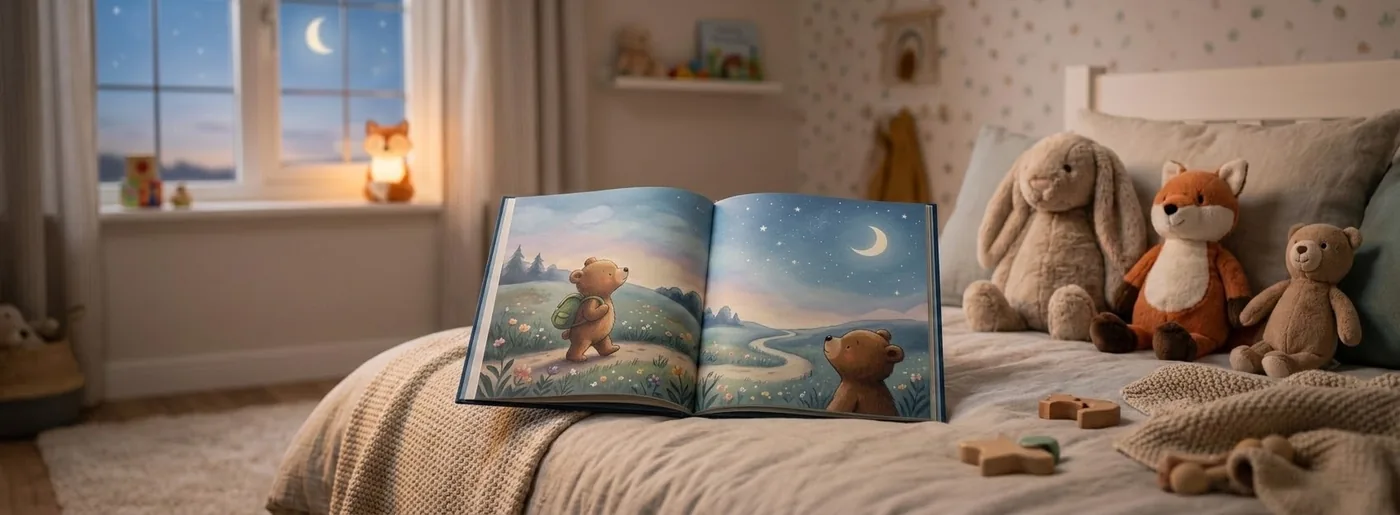
Writing a rhyming children's book: when it works and when it doesn't
Writing a rhyming children's book sounds easy—until that third line just won’t fit. Rhyme can make a bedtime story magical for little ones, but forced rhymes can break the flow. With a few simple tests, you can decide if your story truly needs rhyme or if it’s better told in plain sentences.
You’re at the kitchen table with a great idea. The first two lines come naturally:
Once there was a little bear named Sebastian,
who decided tonight he’d travel to the moon and back again.
You smile—this sounds musical. But then comes the third line. Sebastian needs to grab his coat and pack a backpack, but nothing rhymes with "moon." Before you know it, you’re writing, “he quickly put on his favorite blue pants,” and suddenly your space adventure is all about getting dressed. The story ends up in your folder of unfinished projects.
Rhyme is one of the trickiest styles in children's literature. Still, it’s a powerful tool: research shows rhyme and rhythm help young children develop sound awareness. The key is knowing when to use it.
Rhyme or prose? Make a conscious choice
Rhyme works best for books aimed at the youngest readers. For babies and toddlers, sound and rhythm matter more than meaning. They love cadence, predictability, and repetition—and these help them learn to recognize sounds.
If you want to tell a more complex story—with a plot, character growth, or big emotions—rhyme can quickly get in the way. If you find yourself changing plot points or making characters act strangely just to make a rhyme work, switch to prose. A strong storyline in regular sentences almost always beats a forced rhyme scheme.
Spotting forced rhyme
The biggest pitfall is forced rhyme: when you twist sentences just to make the ends match. In English, this can lead to awkward phrasing or "Yoda-speak." Here are two examples:
Reversed verbs
The big bear who into the deep woods did go,
while loudly with his gentle voice did he bellow.
No one talks like that. More natural would be:
The big bear walked bravely through the quiet wood,
and softly called out, “Is there anyone who loves honey as much as I could?”
Filler words
The cat who sat on the soft, green grass,
was now very wet from the rain that did pass.
"Now very" just fills space. Stronger is:
The cat sat shivering on the soggy lawn,
wishing the rain and the cold would be gone.
Rhythm matters more than rhyme
Perfect rhyme with a clunky rhythm still reads awkwardly. Rhythm is the beat of your text: the stresses should fall in predictable places. Two rhythms feel most natural in children’s books. The iamb (da-DUM, da-DUM) is a gentle, walking rhythm: “The sun shines bright on grassy hills.” The anapest (da-da-DUM, da-da-DUM) gallops along and suits lively, active stories: “Like a bird who is free in the sky.” Pick one rhythm and stick with it throughout your book.
Using a child’s name in a rhyming story
If you’re writing a personalized children's book where the child’s name changes, there’s an extra challenge. For example: “And then Sam jumped into the puddle so fast” flows nicely. But swap in “Jonathan,” and the rhythm breaks. The solution? Place the name in a rhythm-neutral spot, like at the start of a line with a comma:
Look over there, [name], what a wonderful start.
Together we’ll walk through the woods, ready to take part.
The comma creates a natural pause, so it doesn’t matter if the name is one or four syllables—the rhythm of the rest of the line stays intact.
Test your rhythm out loud
You’ll only hear where a reader might stumble if you read your story aloud. Tap your foot to a steady beat and read your lines in the Mr Tales writing tool. If you have to rush a word or pause awkwardly, your rhythm is off. Shorten the line, change the word order, or cut filler words. Even better: have someone else read your story out loud and watch where they trip up.
Frequently asked questions
Does a children’s book have to rhyme to be popular?
No. Most award-winning children’s books are written in prose. Prose allows for deeper characters and more subtle humor.
What’s the easiest rhyme scheme to start with?
Paired rhyme (AABB): the first two lines rhyme, and the next two rhyme with each other. Young children love this—it’s predictable and soothing.
Your story deserves the right form
Whether you choose sparkling rhyme or the freedom of prose, what matters most is that your story connects with the child. Ready to write and publish? Learn more about becoming an author with Mr Tales or start small with our Mr Tales creator tool. For more writing tips, check out our practical advice to make your story stronger.